Signs your MSA has outgrown its structure
- Clients redline sections that don't apply to them.
- The same service is described in more than one place.
- Every client gets terms written for a different kind of customer.
- Cross-references break whenever someone adds a clause.
- The SOW is a menu of every service instead of a description of what was sold.
The modular structure
The one rule: the core never mentions a specific product.
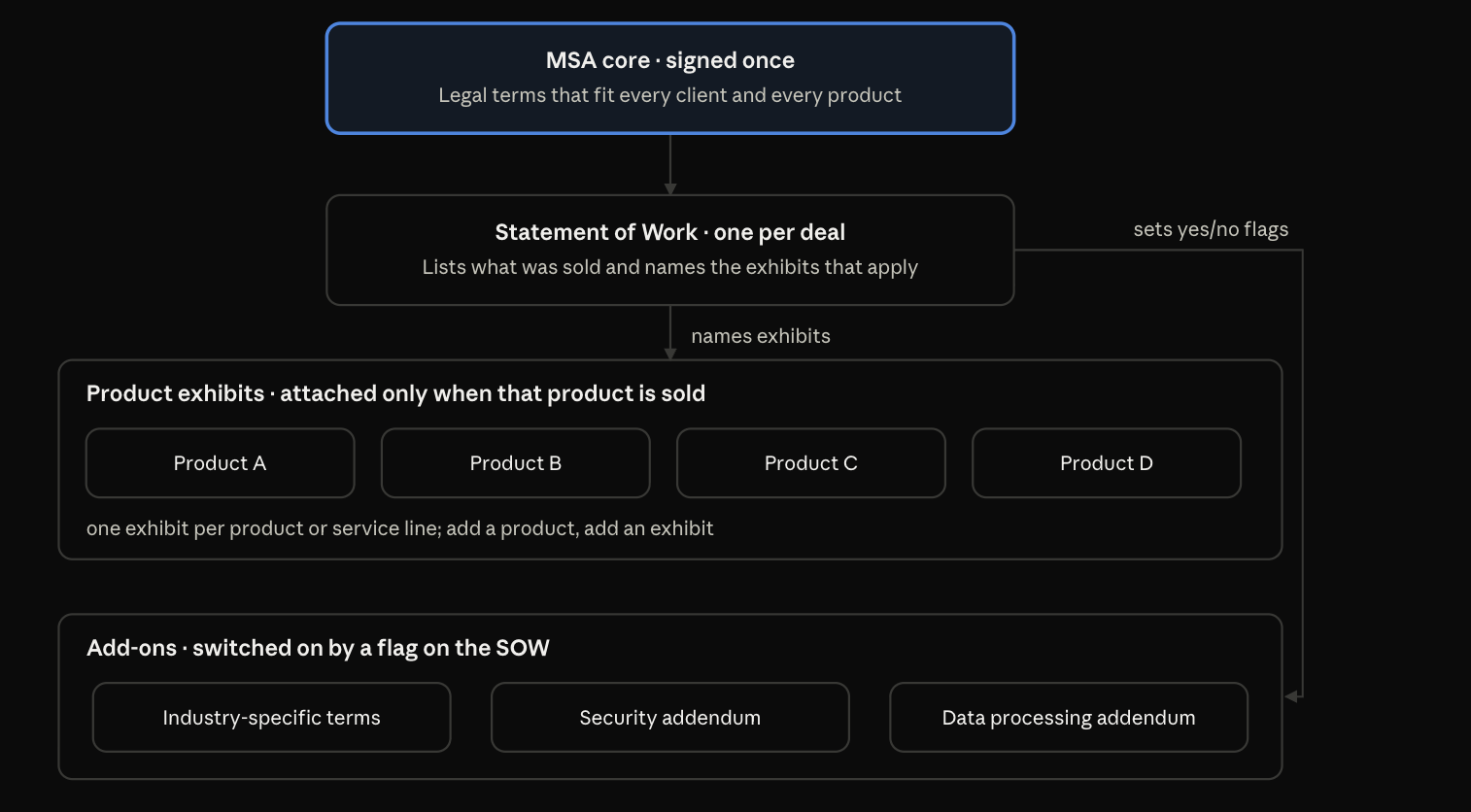
- Core agreement: terms that are true for every client, such as confidentiality, liability, payment and termination. Signed once.
- Statement of work: one per deal. It lists what was sold and names the exhibits that apply.
- Product exhibits: one per product or service line, attached only when that product is sold.
- Add-ons: terms triggered by a situation rather than a product, switched on by a yes/no box on the SOW (for example, a data processing addendum).
Two clauses in the core hold it together. An exhibit binds the parties only when a signed SOW names it. And an order of precedence settles conflicts: core over exhibit, exhibit over SOW, unless a document explicitly overrides a specific clause.
The sorting test
Ask one question of every clause:
- True for every client? → Core.
- True for one product? → That product's exhibit.
- True for one deal? → The SOW.
How to restructure, step by step
- Agree the principle first. Settle the structure before anyone edits text.
- Work in a copy. Keep the live template usable for deals in progress.
- Map every section to its new home (core, exhibit, SOW or delete) before drafting.
- Move clauses; don't rewrite them. Tag any new language so counsel knows what to review.
- Keep one list of open decisions and review it with counsel in a single sitting.
- Send a redline against the old version with every draft, so reviewers can see nothing was lost.
- Automate last. Automating a messy document only makes the mess faster.
Trade-offs to plan for
- More documents to version. Record on each SOW which exhibit version applied at signing.
- Precedence must be airtight. Three layers means conflicts are possible; define who wins.
- Sales needs a new habit. Picking the right exhibits is a checklist item until it's automated.
- Consolidation can shift meaning. Merging repeated clauses is where subtle changes creep in, so have finance and counsel confirm.
Why this is an operations win
A modular contract has the same shape as your data. Exhibits map to the products in your CRM, SOW lines map to deal line items, and billing can follow both. That makes contracts easier to reconcile, easier to generate automatically, and cheap to extend: a new product means one new exhibit, and existing clients never need an amendment.
It's one of the ways we're building the best operations in the business at Cantina.
Not legal advice. Have your own counsel review any contract changes.