Most startups treat their Terms of Service like a fire extinguisher. You buy one, hang it on the wall and never look at it again. But terms are ops infrastructure. They break the same way a CRM sync breaks: slowly, quietly, and at the worst possible moment.
This is not legal advice. It's an operator's view of how to keep public terms, product terms and signed contracts in line with each other, and the system that makes it repeatable.
The problem: terms drift while the business moves
Fast-growing companies launch products, change business models and sometimes move domains. Their public terms rarely move with them. Put them side by side with the signed contracts and you usually find three kinds of drift:
- Terms that fight the contracts. Website terms that claim to override any other agreement, while every enterprise contract says the opposite. Both can't win.
- Terms that describe an old business. Retired processes, outdated payment methods, refund rules from a model that's no longer sold.
- Terms that disagree with each other. Different notice emails, different courts, different words for the same people, different liability caps.
None of this was anyone's fault. Terms get written once, by whoever is around, for the business as it is that month. Then the business keeps moving and the documents don't. Sound familiar? It's the same failure as a stale field mapping between sales and finance.
Lesson 1: draw the hierarchy before you edit a word
Before changing a single clause, map which document wins when two of them disagree. It takes an afternoon and it's the most useful step in the whole exercise. Every later decision gets easier, because the question changes from "what should this say?" to "where does this belong, and what sits above it?"
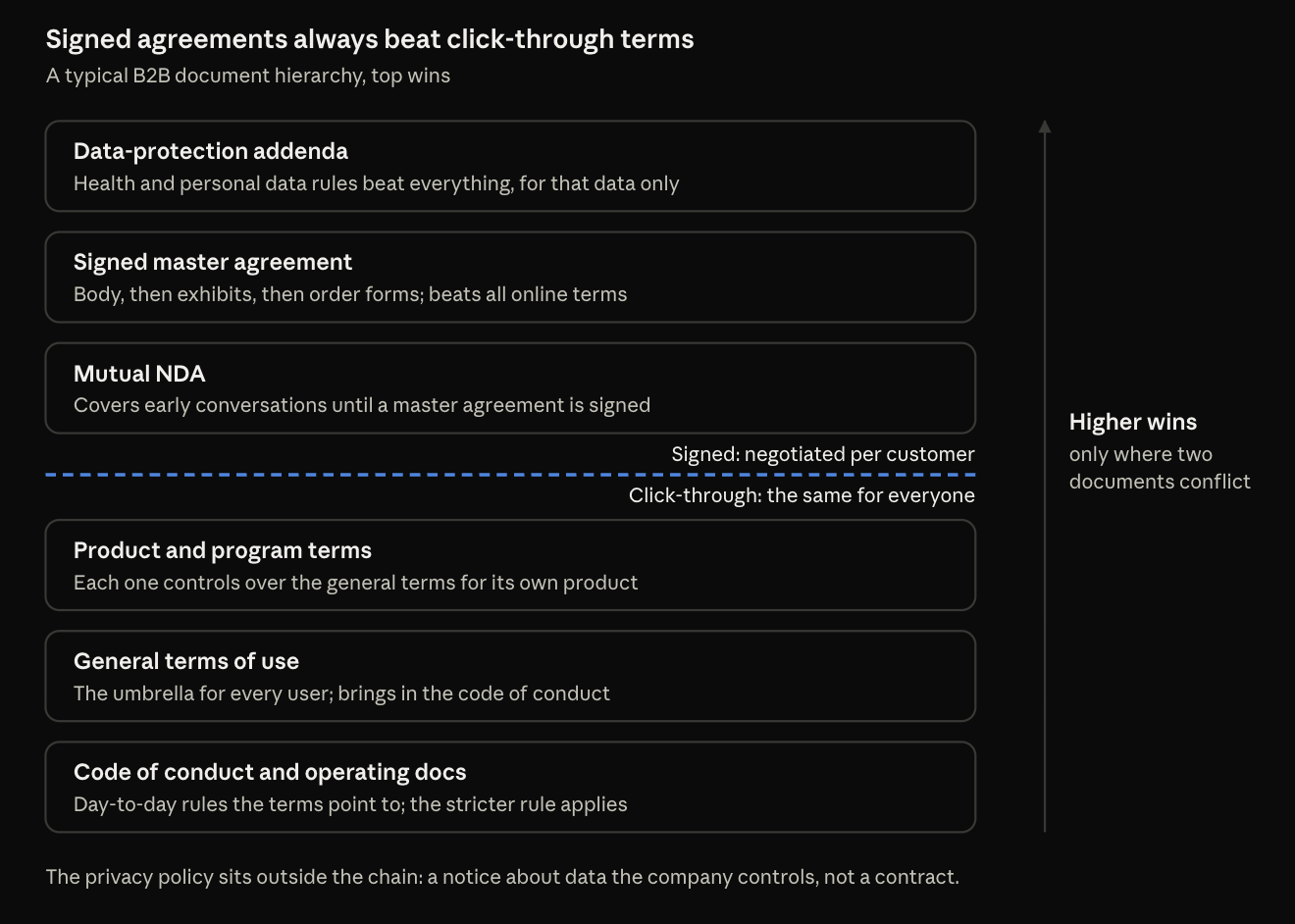
The big rule is the dashed line. Anything a customer signed beats anything they clicked through. Website terms that claim the opposite create a whole class of conflicts, and fixing that one sentence removes them. Then give each product's own terms one line saying they control over the general terms for that product, so two documents never fight over the same ground.
Lesson 2: terms should describe how the business actually runs
The best source for a terms update isn't another company's terms. It's your own operating docs, your SOPs, and the people who run each process every day. For each clause, ask one question: is this what we actually do?
Common places where that question changes the text:
- Payments held for compliance. If you hold a payment until tax or identity checks clear, say "held", not "forfeited". Don't threaten to keep money you would never keep.
- Disputes. If disputes are really handled in a tracked tool, point people there, not to a general inbox.
- Who does the work. If some contributors are employees and others are independent, the terms should allow for both.
- Deadlines you don't control. If a payout depends on a third party funding first, don't promise a fixed window.
A simple rule: if a clause would surprise the person who runs that process, it's wrong. Rewrite it until it describes their Tuesday.
Lesson 3: the process matters more than the prose
An AI assistant is a great drafting partner for this kind of work, but only with a few working rules set on day one:
- Suggestions only, never direct edits. Every change goes into the document as a tracked suggestion. A person accepts or rejects each one. Nothing changes without a human decision, and you keep an audit trail of every edit.
- List the open items before touching a document. Start each doc with the full list of problems, pick which to fix, and park the rest on purpose instead of by accident.
- Flag anything invented. If a period, an amount or a process didn't come from a source (a contract, internal docs, a person who owns the process), it gets labelled as made up. This one rule catches more problems than any review.
- Name the biggest tradeoff. Every recommendation comes with its main downside. "Remove the payment deadline" is easy to accept; "remove it, and users lose a guarantee they used to have" is a real decision.
- Check the market, then decide for yourself. Comparing with how peers handle the same clause shows you what's normal. It doesn't tell you what's right for your business.
The point isn't the AI. Any drafter, human or not, will fill gaps with confident text. The process is what makes those gaps visible.
Lesson 4: consistency is a system, not a proofread
Most conflicts aren't big policy questions. They're small facts written differently in different places. So write down a short list of conventions and apply it to every document:
- one inbox for legal notices, one for security issues
- one governing law and one court, everywhere
- one way of calculating liability caps
- one name for each group of people (customers, contributors, reviewers)
- one domain for every link
- a line in each product-specific document saying it controls over the general terms for that product
Then build the boring infrastructure that keeps it true:
- A tracker. Every document and every open item, with an owner, a status, a priority and what it depends on. Closing stale rows matters as much as adding new ones.
- A version log. One row per published version with its link, date and a saved PDF. When someone asks "what did our terms say in March?", the answer takes ten seconds.
- A context doc. A short write-up of the rules, decisions and reasons, so the next person (or the next AI session) picks up where the last one left off instead of starting over.
If this sounds like a data pipeline, it is. Documents are records, and conventions are your schema.
Where to start
Keeping terms healthy isn't a big project. It takes an owner and a habit. If you have an afternoon:
- [ ] Put every public legal page and every signed template in one list, with links.
- [ ] Draw the hierarchy and make sure every document agrees with it.
- [ ] Read each clause next to the person who runs that process.
- [ ] Pick your conventions (emails, courts, names, caps) and apply them everywhere.
- [ ] Start a version log before your next publish, not after.
- [ ] Review the stack whenever you launch a product, change pricing or move domains.
Know where your limits are, too. Anything that changes who carries risk, how money moves through you, or whether a clause is enforceable goes to counsel. Keep a running memo of those questions instead of guessing. The ops job is to make the lawyer's hour count: clean documents, clear questions, and a list of what's already decided.
Terms aren't a fire extinguisher. They're a pipeline that needs an owner, and that owner can be ops.